Handless Women
Miriam Schonwetter
Penta of the Chopped-Off Hands begins her story with all limbs accounted for.
She is beautiful and trivial and adored. Most of all by her brother, the widowed king of Dry Rock, who introduces himself into her narrative by inviting his sister into his counsel and asking if she would not rather be his wife. There are no Wuthering Heights ambiguities, no Leia and Luke reveals. No one likes that he does this. Least of all Penta.
Her rejection is clever and swift. Her mistake, if she can be said to have made one, is asking which part of her has led him to this, as she is not yet so great of a beauty as to regularly drive men to in-breeding. He cites her golden hair, her gemstone eyes, but it's her hands at the center of his fetish, mothering and nimble and frail. The ability to create and maintain tied inseparably to what may be most easily crushed or stripped away. She is satisfied with this answer and asks to be left alone.
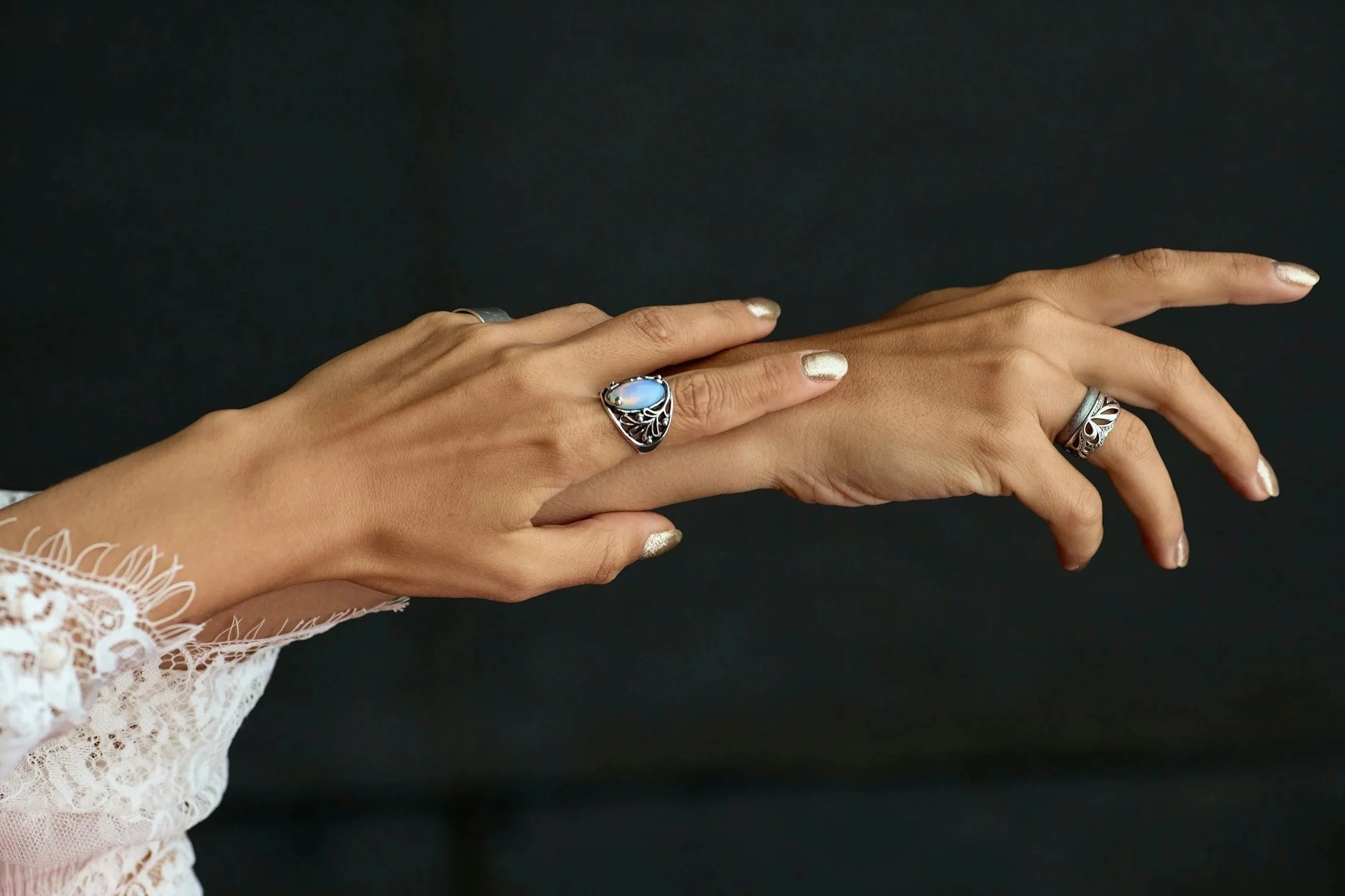
Penta returns to her bedroom, which we must imagine to be overflowing with pink and lace, pressed flowers pinned to walls and golden jewelry hung from doorknobs for lack of will to hide it away in closets or boxes. She pays a slave to amputate her hands at the wrist and has them delivered to her brother with wishes for a happy union and healthy baby boys.
Her brother, enraged, has a coffin tarred and Penta thrown into it. The lid is nailed shut and she is cast out to sea.
-
My mother's favorite child is the cherry tree in her front yard. It's the Jamaican type, its fruit small and sour with seeds that burst like dying stars between your teeth. Its highest branches scrape over the top of her roof and at night, and you could mistake the sound for that of someone scratching at the windows, pleading to be let in.
When it's in bloom, a stepladder and broom pole are employed as tools of the harvest. For weeks, each shelf of her freezer is filled with neat rows of cherry-filled ziplock bags which will gradually be boiled down into bitter-sweet jam. Her fingers are stained red from the first day to the last - evidence of bloodlust in an otherwise vegetarian household.
-
Because Death cannot be so easily called upon in a story where his name may be capitalized, Penta doesn’t drown. Instead, she's found by sailors and brought home by the chief. His wife, who is jealous and spiteful and Nuccia, gets him drunk and waits for him to fall asleep. She shuts Penta back into her coffin and leaves her again for the tide.
We must assume that Penta does not resist.
-
Commonality of Immaculate Conception in Vertebrates:
Amphibians – Extremely. Lots of salamanders, lots of frogs.
Reptiles – Fairly. Fifty species of lizard, one species of snake.
Fish – Not uncommon. Twenty-one species, including sharks. Viability varies.
Birds – Rare. Three species. One condor and two domesticated fowls. Often abortive.
Mammals – Miraculous. One recorded case. Validity unconfirmed.
-
For five weeks, I sit in the back of a lecture hall where all anyone can ever seem to talk about is Lavinia. We track Titus Andronicus' progress through the titles she carries. She is a daughter and she is the gem of Rome. She's disowned by her father and becomes a wife. Her husband dies and now, handless and tongueless, she becomes a daughter again. She is dead and the play is over.
Costuming is a highlight. We talk about what she wears, if a production uses pig's blood or red streamers to symbolize her loss of autonomy, if the climatic dinner scene sees her dressed in widow black or bridal white. We've just finished Hamlet. We align her with Ophelia, who does not lose her hands but does lose her mind which ties them closely enough together to warrant our comparison. We dissect all fifteen lines of her dialogue. We talk about her relationship with her father, her brothers, the play’s racial commentary. We discuss how her uncle should react when he finds her maimed and mutilated in the woods, how we would expect ourselves to.
Titus Andronicus is not a very good play. Lavinia is not a particularly dynamic character, but she has no tongue and she has no hands.
Speaking on her behalf comes naturally.
-
To do is not to be is not to create. To create is not to be is not to do.
It can be very hard to do once you've become.
-
The coffin is discovered next by the king of Green Earth, who mourns that a trunk of such precious treasure was found without its handles. For her beauty, Penta is given to the queen, who is kind and sickly and childless. Surprisingly, the queen is not jealous, and Penta is loved as a daughter. She is allowed to thread needles and comb hair and do things that make her useful, that make her family. Unsurprisingly, the queen dies a month later, and our second widowed king takes Penta as his next wife. Freud’s Oedipus Complex tastefully reversed.
We must wonder if Penta grieves. If she rambles the halls of her castle in black or in white, candle smoke and incense heavy in the air. Singing church bells cause her stomach to turn. She's the happiest she's ever been as she walks down the aisle. She speaks her vows through tears. She is glad to be safe. She never considered herself to be in danger. She has her coffin burnt as soon as she reaches dry land. She uses it to bury her queen.
The king weighs anchor the next morning. Penta is already with child.
-
In a theater named after a bird because it could not be named after a man, we see the first production of Titus Andronicus performed in England in the past ten years. The stage is a runway, distended into the audience with a wall of glass erected on all sides. The sprinkler system is clearly visible above head, lowered deliberately into plain sight. We've been warned that this production uses record breaking amounts of prop blood. Half the fun is knowing that it's not real and joyfully wondering what form the carnage will take. The other half is forgetting all
of this once the lights dim.
The amnesia only truly takes hold in the scene leading up to Lavinia's dismemberment. I grip the arm of my chair tightly enough to leave crescent moons in the laminated plastic. The woman to my left buckles into herself and for lack of space, hides her face in my knees. She only resurfaces once Lavinia reappears, choking on a mix of red-dyed water and corn starch, her hands dulled into stumps by bandaged-wrapped prosthetics. The lead-in is unbearable, eight lines of Lavinia's fifteen spent pleading for modesty in death. The silence of the aftermath, we can sit through more easily.
-
Penta has a son. We must believe that she loves him. The story becomes untellable if she does not.
Word is sent to the king, intercepted by Nuccia, and the story instead becomes that she has given birth to a wolf-dog and both her and the child are to be burnt. Confused and pitying, the king’s advisors exile her instead. A servant binds her child to her back and she walks for days, sustaining him with tears and milk.
It's her suffering that leads her to the sorcerer of Torrid Lake - not a king and not of land. He welcomes her as a father might, out of love and out of pity, and at no point attempts to marry her. Thank God.
-
Titus Andronicus is not a fairytale. Lavinia is not a princess.
-
I tend to fall in love with hands first, then the rest of a body later on. My preference veers thin and nimble, the type you would imagine picking the rust-shut locks of dungeon cells or weaving tapestries in high, weather-beaten towers. My current lover can bend her wrist back so far that her fingertips brush against her forearm, an act of contortion I’ve come to think of as our courting ritual. There is nothing more beautiful in the world than lines of an open palm, the cuts and creases mapping out the life of the person you love most in the world.
My adoration for women’s hands is tied closely to my respect for the women they’re attached to, a detail I hope will let you deem me a Romeo, not a Paris. I am aware that this scene aligns me with the fetishizer, not the fetishized. I know that its inclusion is not in my best interest, as your storyteller. I’m not sure what this means for Penta.
-
Behind the theater, after the play, I lean on a guardrail next to the woman who could not stand to watch. She has two hands, her entire tongue, and one more tooth than she ought to. Her hair is a pale enough shade of red to halo gold under the light of a nearby streetlamp. She tells me that she's married, and that she writes, and that she tells people the first one first and the second one second because she knows that her writing is good, not great, and has thought about ending her life because of it before. How good she is at being married doesn't seem to be as much of a concern.
I tell her about my life-long fear of immaculate conception, amputation without infection, the becoming without the doing. I’m trying not to mention my own writing, which I believe to be great but I dread is only good. I haven’t thought about killing myself because of it, yet.
It's cold. At some point, she pulls the sleeves of her jacket over her hands and balls the cuffs in her fist and I do the same. Like this, we become handless. Like this, we are talking about Lavinia.
-
What happens to Penta's king-husband and king-brother are not important to us but Penta cannot exist without them. Both are summoned to the sorcerer, both mourning wife and sister and ward. Penta forgives them. It's unclear if she knows that's what she's doing.
Penta ends her story a wife and a mother and a queen. Her son inherits the sorcerer's kingdom. Her king-husband rules on his behalf.
We do not know whose hair she now combs.

Miriam Schonwetter