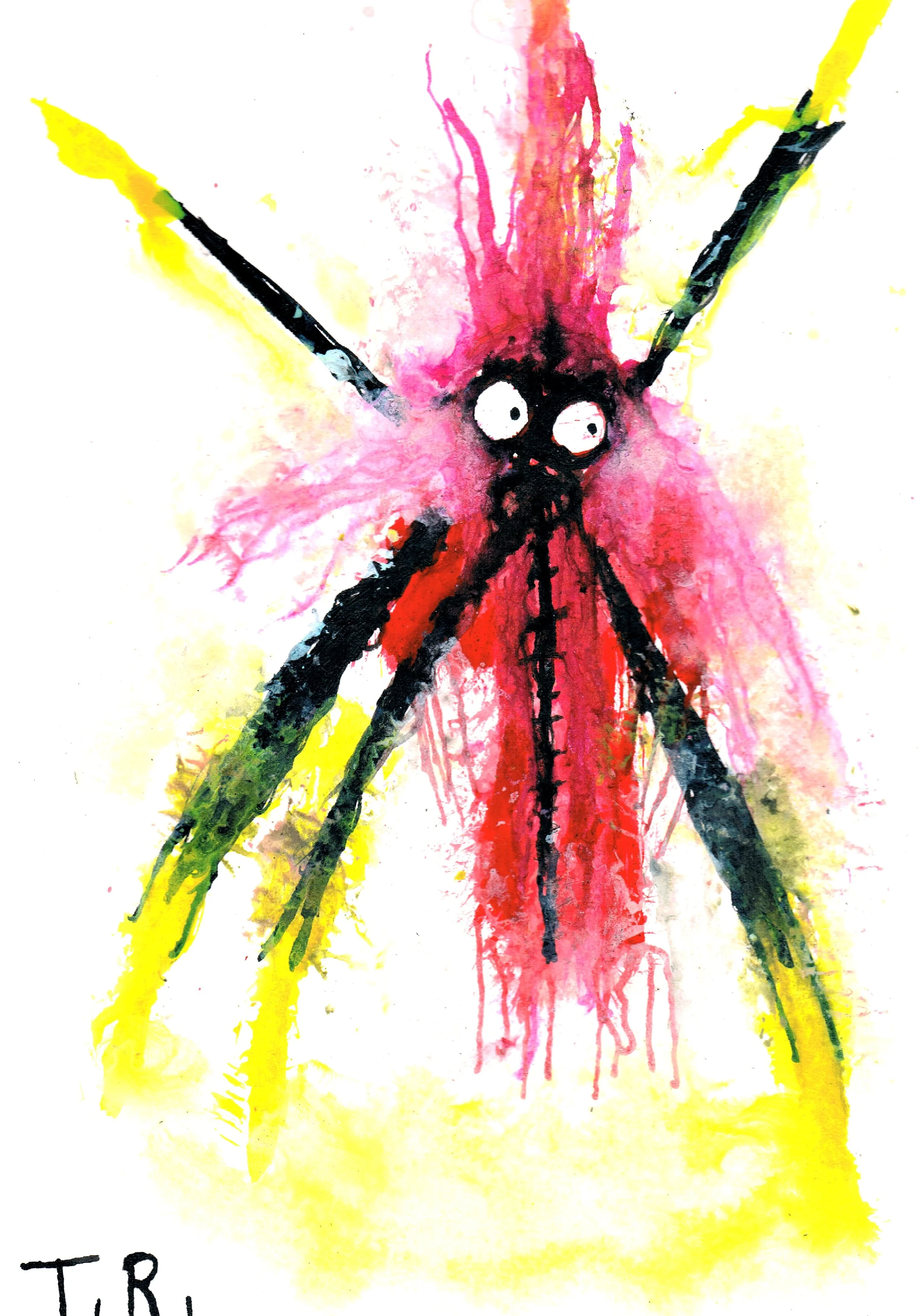
Cringe
Ian Lindsay
You almost knocked bulimia when you started doing stand-up. In fact, you’re driving to the stage now. Laughing Skull, Texas. Back in your open mic era, audiences laughed from sympathy—bits so deadpan, if they didn’t laugh, their teeth crumbled. Years working the road earned you a revolving headliner, but the warpath to laughter never got easier. The jokes. They turn your pain into something higher. A Filipino, you know this well. Pain is your lineage. So is laughter. The sound can fill you—wind through your body like sustenance, settling in your gut.
Old haunts are ahead. Starts with Burger King, ends at Sonic. Locals call it the ‘Sheen:’ an eight-lane tollway, where for miles, sun glints off Ford windshields parked in the dealership’s endless rows, fast food at the highway’s edge. You fight the image of driving home in the late, dark. Bombing leads to the Sheen, leads to Dasani leaving, which leads to death. Eating until the gristle rises.
Your eyes drift from golden arches to traffic. When you arrive on stage, you’ll smile. The audience will shift uncomfortably. You don’t smoke. You’ve quit the ‘pharmies,’ the downers that gave your demons some chuckle. Doctors know why you smile with closed lips. Purging came from where all things come: the gut. Maybe it started with your mother? No, you’ll never blame her. More likely it’s your uncle’s fault. He showed you the door and room you keep closed. You don’t want what happened to you in there to get out. He had a potbelly. A growing watermelon seed. That’s where jokes come from: the gut.
This morning, in the tiny apartment you share with your girlfriend, you read a group text from Vale, the club’s owner, which resurrected a joke, one you’ve killed with in the road days. Past your screen was the popcorn ceiling above lace-white walls. Inferno Cop, Dasani’s favorite anime, played low on the TV. She was tangled in the bed sheets. Maybe her physical body had wrestled a phantom one? You marveled at her clavicle. Such an intimate bone.
“I have a new bit,” you said. “From when we were young.”
“I hate when you talk about me.” Dasani pushed off the bed. “You’ve already shit on me to half the country.”
An old bit was Dasani’s name. Her parents named her after the first sign they saw in the States. “It’s private,” she’d said. So, you let that joke rot. Dasani’s childhood makes you ache. A painfully shy child who’d only spoken Tagalog and endured enough humiliation for a lifetime. Her first American school thought she had an impairment, put her with the disability children. Her first-grade teacher knew right away, tried to get her out, but her parents—new from the Philippines, not like your family who settled two generations back—needed the federal check.
Dasani’s teacher held a conference, had the P.E. coach bring the class back early. She wanted her parents to see Dasani’s classmates, this morning’s cereal dried on their T-shirts, saliva, tiny hands whipping back and forth like undeveloped wings. Sometimes you think about her classmates, and you’re envious. The only pure ones. They have their own world, away from this cruel one.
“Up,” Dasani said, pulling the sheets. “I’m making the bed.”
You helped her fluff the pillows, felt heat across the queen. “That was a cheap joke,” you said. “But this one’s good. Nice and self-deprecating. I’ll weave it as a callback to punchlines through the whole set like Eddie in Raw.”
“You have to self-deprecate? Why do you need to talk about us at all?”
“Comedies changed.” You tucked the sheets. “The country’s changed. I have to push deeper, yank out the funny from my own embarrassments. Anything else gets me canceled.”
When Dasani spoke again, she spoke as Donald Duck, mocking your favorite phrase. “Telling a joke is like telling a story.” Vicious, cartoon-fowl noises. Her fingers became feathers.
You riffed, switched into Goofy. “Gawrsh,” you said. “Golly! I point one way, punchlines come from the other direction.” Continuing the bit, you imagined a white glove on a raised finger making your point. “I catch the audience off guard, and they laugh. I get mean - ah-hyuck! - they laugh harder. Parodying my life is the best way.”
Her blue sailor shirt faded. “Go up there and shit on yourself all you want. Just keep me out of it.” She glanced around the room. When Dasani’s angry, she goes from one chore to the next without finishing. If the joke is told, little dirt piles will go unswept. She sighed. “What’s the bit about?”
“That time you cut me. With your mouth.”
“I had braces!” she said. “Absolutely not. No.” She looked everywhere but the place where you stood. “I was –”
“Mortified?”
“I thought about breaking up with you before you broke up with me first.”
“We were kids,” you said. “It’s funny! Happens all the time. People just don’t talk about it.”
“That’s how it should be.” Dasani turned, reaching for the doorknob. “It’s private.”
You coaxed her back. “Can you hear the joke first?”
“Not if it’s about me accidentally cutting you.” A twitch in her brow. “Just do your regular stuff.”
“That won’t be enough. Vale texted. Apparently, a talent agent with ins at Netflix is coming tonight.” You cut her off. “Trisha Labelle, the one always gunning for headliner, if she gets this agent’s attention, there goes my career.”
“Just go up there and be funny.” Dasani exchanged breath between cheeks. “You’ve worked your material for years. It’s all good.”
“If I ever want to get a special, you know, follow my dreams, I need to move beyond stupid character and deadpan. Comedy’s the only thing keeping me from binging.”
“That’s really manipulative,” Dasani said.
You feel empty. “Alright, I won’t tell it.”
Dasani’s lips smiled, her eyes frowned. “Be a Pokémon,” she said. “Evolve.”
“I will,” you said. And you meant it.
Past the Sheen, you drive the veins and arteries lassoing into downtown. No sunset to walk off into here. Only an hour to sit with the other comics backstage in the tiny green room. You sweat, imagining the photographs out front of Vale posing with the greats. Bill Hicks, Sam Kinison, Jimmy Pineapple. The mind drifts. You rehearse jokes in your head, ignore the decorative candy bowl. Trisha LaBelle’s set plays on the PA speakers. Cheers muffle through the walls. You’re on in five. You stalk the left wing.
Ovation carries Trisha offstage, and she struts past you.
“Trisha,” you say. She turns. “Good set.”
“Hey, Jo Koy!” she says. “Appreciate that.”
You’ve heard the Jo Koy line before, and your molars grind. “I need advice,” you say. She approaches. You smell the woods in her perfume. “I want to try out an old road joke, but it’s raunchy and personal.”
She relaxes, understanding your question is genuine. “How personal?”
“A story about my girl. She bit me when—” You poke your tongue into your cheek.
She waves her thumb and index like a gun, chuckling. Her laughter feels good.
“That’s funny,” she says, nodding toward the house. “They’ll love that one.”
“Only issue, my girl doesn’t want me to tell it.”
A crash of broken glass rips from the balcony.
“I don’t know how you do it,” Trisha says. “But I sell everything I say out there. You lie or do it without your people’s blessing—that’s glory surfing. Won’t last long out here doing that.”
You nod.
Then you’re on, squinting against the stage light, not wanting your eyes to adjust. Resisting the forbidden joke, you start with regulars. Caricatures of old, demented cartoons that you used to hide in. You gurgle your throat. Pinch your nose. Flip your tongue. SpongeBob voices rise from your belly, and you act out dirty versions of your childhood television.
Between bits, you scan the crowd, appraising. Stage-right, in the back row, is a figure sitting alone in a dark hood. Ghoulish, you think, but you’re halfway through telling the shit-your-pants joke.
“Not a man ‘til you shit your pants.”
Light chuckles. The bit continues, linking masculinity to excrement.
The hooded figure quakes. Is this laughter or pain? Under the hood, you think are bones, a skull. The audience doesn’t notice. They’re busy with the story of you becoming a man.
“Morning Taco Bell,” you say. “A boy fires his bowels, and then…” You pause.
Is the hooded figure holding a scythe?
“He’s entered the fraternal order of manhood.”
You wet your lips, raspberry the mic. Eyes roll. The figure chuckles, arching its shoulders like your mom when she scolded you before feedings.
When you were a child, your mom left food for opossums to forage in the night. When you could reach, you turned on the porch lights and looked through the glass door, laughing when the opossums froze, pretending to keel over dead. You wanted to nudge them—get them to stop pretending. One night, you’re caught.
“Leave them alone,” Mom scolded, arching her shoulders, making you wince. “Before the tollways, our neighborhood was filled with animals. How you like if someone came into your room, broke your toys, and made you live in the corner?”
You fought tears back. “That’s why they fake dead?”
“They’re scared,” she said. “Let them be.”
She turned off the porch lights.
“Do I have to go to bed now? I can’t. I’m too sad.”
“Want ube pandesal?”
You nod your head emphatically.
“Poor animals are always fed in my house,” she said, handing you sweet bread rolls.
Your set’s doing okay. You’ll have to keep that up. Never the Sheen after bombing. Fast food neon bright against the dark sky. You need to resist the neon, drive back full of laughter. So, you fight for every chuckle, put your heart and soul into the punchlines. Nothing compares to the wolf howls Trisha had worked up. You pivot from raunchy back to deadpan. The audience is polite. No knee slaps. No braying donkeys. Should you tell the braces story? You know it will kill. You hold the mic and study the crowd, eyeing the hooded figure. Would the talent agent dress like the Reaper? The stage lights illuminate a clavicle.
Everyone cried at the funeral seven years ago. You’d only met Dasani’s títo a few times, and the eulogies were beautiful enough to break you. Afterward, you drove, and she held your hand. You both were quiet. Years with Dasani, and despite you being defective, she cried on your shoulder. Red eyes against winter skin.
Dasani broke the silence. “We shouldn’t go home. We need to go somewhere else first.”
“Why?”
“Pagpag,” she said, taking her hand back. “Don’t go straight home after a funeral, or a spirit follows you.”
“They call the dumpster-trash people eat back in PH pagpag.”
“Well, that’s not what it means,” she said. “No ghosts in our apartment.”
Outside the car window were storefronts like the Sheen where you torment.
“How about a walk?”
“No,” Dasani said. “I’m hungry.”
You found a strip mall Chinese place empty enough to already be haunted and sit down, warding the bathroom. Dasani ordered hot and sour soup. For you, spareribs. You paced yourself—bites that wouldn’t swell your body—still able to link your index and thumb around your wrist. Dasani was a million miles away, watching mushrooms and tofu swirl.
“You’d never think he went to war,” she said to the window with the neon by your table. “My first memory of him was watching America’s Funniest Home Videos—people falling. He’d always say, “hayop ka,” and let me laugh when I felt like it. Not like the rest of my family.”
Dasani was saying real, sad, human things. What to say back? You weren’t sure, so you focused on tiny, vermin-bites. Saliva cut the grease; the pork tasted like oil. The plate finished, your gut protruded, and your stomach leaked into your throat, all reflexes.
You lurched into the bathroom, hunched over the toilet, and she followed. The ribs emptied efficiently. Dasani’s knees were on the brown tile. She rubbed your back. When you stood, you saw her in the mirror, fuzzy from tearing.
“I’m sorry,” you said.
“This is killing you.”
You realized she’d been waiting for this moment. Of course, she’d always known. You wondered why this woman chose you, and if she’ll keep choosing that way.
“Let’s find something you can exchange for this.” Her eyes were on the toilet.
You flushed it. “I’ll stop,” you said. And meant it.
On stage, a ringing. Loud, shrill, metallic, like amplifier feedback. The sound is deafening against the dry silence in the Laughing Skull’s auditorium. You force a laugh into the microphone, hoping for contagion. A drunk person yells. They always do.
You give them a wide-eyed, crazed look. Eyes like trash can lids. Then you launch into character, clearing your throat for the pearl diving bit: masturbating in a pool, semen floating up like pearls. You see a couple in the second row. One laughs. His partner slaps him. A good slap, but his partner laughs out of politeness.
Then you see the hooded figure resting a skeletal hand on a belly.
“Knock, knock.” Your uncle’s crude oil voice was outside your childhood door. A Gundam Wing poster was pinned to your wall. Sitting on your bed, you were waiting for your uncle to come. The baseball team you played for doesn’t use whiffle bats anymore. No T-Ball stand. The one you held was aluminum.
“Who’s there?”
This time will be different. You’ve pictured the doorknob twisting, your uncle’s belly, then the rest of him. You planned to use that aluminum. Swing, swing, swing, until his face was pot roast, his hands uncooked links. The belly, a bludgeoned slab. Then he can’t do what he’s always done.
The door opened. You stay seated, the bat hidden under a pillow. Under the sneer of his gaze, something was gone in his eyes. He wasn’t hungry. Not for you anymore. Why?, you questioned. What’s wrong with me now? You gripped the bat. Your uncle appraised, and then his eyes left your body, hovering over the Pokémon cards and Tamagotchi key chains on your bedside table.
“Who’s there?” you repeated.
“A chicken.”
“A chicken, who?”
Your uncle shook his head. “Never mind,” he said. “You’re too old for this joke.”
He closed your door. And when you heard his car leave the driveway you went to the kitchen.
The Laughing Skull’s auditorium is lukewarm save the Reaper, who’s twitching uncontrollably like a wood roach on its back. What you say into the mic is the only defense against this late-night lull, settling as malaise into the audience. On the road, you’d go political, but not here. Not in Texas. Instead, you autopilot a punchline series comparing the animal kingdom to drug fiends.
“Squirrels are crackheads, And, the opossums, fentanyl.” This last word you speak with slow bass, drooping your chest like so many poor souls hunched over downtown. The body humor gets a few chuckles, so you embrace what they give, and use the mic like a prop hypodermic needle, parodying a ketamine injection. You gallop across the stage on all fours, neighing, pleading for laughter. You feel their wincing, absorb their cringe. Except for the Reaper who is cackling hysterics, rattling the catacombs underneath its hood. In the back, you see Vale drawing a finger across his throat. Time’s up.
You get off the floor and cease being a stoned, tranquilized horse. If you push deep, you have time for one last bit. End on a high note, a pinnacle. Dasani’s mouth enters your mind, bracketed wires affixed to crooked teeth. You walk to center stage, snickering into the mic, soaking up the dead space. You stand in the golden spotlight and end your set.
The front house lights brighten the hung photographs of the greats. Backstage is a crimson glow. You walk past Trisha who is talking to a woman wearing a dark duffel coat. A business card passes from duffel coat to Trisha.
“Hey, Jo Koy,” she says as you pass. You brace. “You’ll get ‘em next time.”
“Thanks,” you say, hearing the pity in her voice, feeling the empty in your gut.
You walk past her toward the green room, where you’ll decompress before the Sheen. You sit on what all the comics call the ‘casting couch,’ stare into the decorative bowl filled with neon-colored candy. You pick up a mint, open the packaging, and crush the candy with your grip, kneading it to dust. The green room door opens.
“Glum, glum, glum.” Dasani’s voice. She sits next to you. She’s wearing her black Inferno Cop hoodie, her favorite anime. “You’re like Cubone,” she says. “My sad little Pokémon.”
“The one with the skull helmet?”
“People say he was a Charmander whose mother died, and the helmet he wears was hers. That’s why he sings his plaintive song. That’s why he cries so much.”
“Did I bomb?” you ask. “I kinda blacked out up there.”
“Wasn’t your best set, but there’s always another one, and I thought it was hysterical.”
“Yeah,” you say. “Always another one.”
“Come on.” She takes your hand. “I’ll drive so you can be good.”
You hold her fingers, and she lets you.
Ian Lindsay is a current Ph.D. candidate. As a Filipino American, he strives to examine hybridity and celebrate culture in writing. Ian is a fiction finalist for Solstice’s annual literary contest and The Steven R. Guthrie Memorial Writers' Festival Contest. He is an assistant editor for Five Points, and his work can be read in The Raleigh Review, Pembroke, Miracle Monocle, and at ianlindsaywrites.com.